
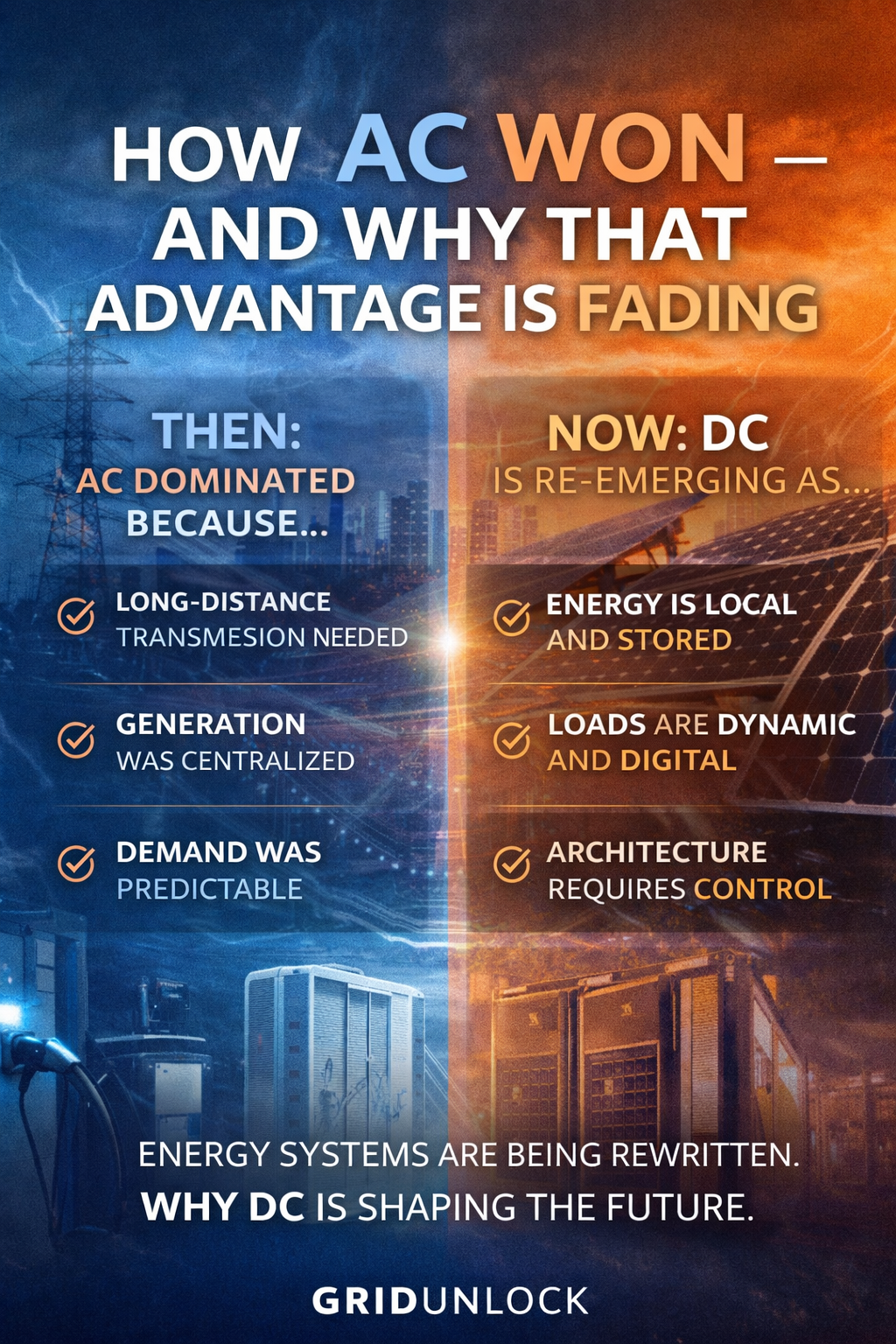
The energy system is now being shaped by very different forces.
1. Energy is becoming decentralised
Solar PV, on-site generation, and distributed resources mean energy is no longer only produced centrally. Much of it is generated close to where it is used.
Solar PV produces DC electricity at the source. Converting it immediately into AC is often a compatibility choice, not a technical necessity.
2. Storage is now central, not optional
Battery energy storage has moved from backup to active operation. Batteries charge and discharge daily, sometimes multiple times per day.
Batteries are DC devices. Every time energy is converted from AC to DC and back again, losses occur and complexity increases. As storage becomes more heavily utilised, these inefficiencies matter more.
3. Loads are dynamic, not predictable
Modern loads behave very differently from those AC grids were designed for!
Electric vehicle charging, for example, is:
-
High power
-
Time-sensitive
-
Often simultaneous across multiple vehicles
Data centres, digital infrastructure, and automated systems require stable, high-quality power and rapid control response.
These characteristics expose the limits of grid-only, AC-centric architectures.
4. Energy systems now require intelligence and control
Modern energy systems are increasingly software-driven. They rely on real-time data, automated decision-making, and fast response to changing conditions.
AC systems introduce complexity for control:
-
Frequency synchronisation
-
Phase balancing
-
Reactive power management
DC systems remove many of these variables, making energy behaviour more predictable and easier to optimise.
Where DC Is Emerging as the Better Fit
DC is not replacing AC everywhere. Instead, it is becoming dominant in specific, high-impact areas.
EV charging infrastructure
EV charging highlights the mismatch between legacy design and modern demand. DC-centric charging systems:
-
Reduce conversion losses
-
Enable battery-buffered, grid-aware charging
-
Decouple charging performance from grid constraints
This is why many high-performance charging hubs are now designed around DC backbones.
Battery energy storage systems
DC-coupled storage improves:
-
Round-trip efficiency
-
Response speed
-
Control accuracy
-
Battery lifespan
As storage plays a larger operational role, architecture becomes as important as chemistry.
Renewable integration
DC architectures allow renewable energy to flow directly to storage and DC loads, increasing self-consumption and reducing curtailment.
Data centres and digital infrastructure
Data centres adopted DC internally decades ago for efficiency and reliability reasons. As energy systems become more digital, similar design principles are being applied more broadly.
The Hybrid AC–DC Future
None of this means AC is obsolete.
AC remains highly effective for:
-
Long-distance transmission
-
Interconnection with national grids
-
Legacy infrastructure compatibility
What is emerging instead is a hybrid model:
-
AC at the grid interface
-
DC within sites, systems, and microgrids
This approach reflects how energy is actually used today and allows infrastructure to evolve incrementally rather than through disruptive replacement.
Why This Matters Now
Energy infrastructure decisions have long lifespans. Choices made today will shape efficiency, resilience, and scalability for decades.
As electrification accelerates and energy systems become more dynamic, architectures designed for a different era struggle to adapt.
DC is not “back” because it is fashionable. It is back because the context has changed.
At GridUnlock, this understanding underpins our focus on DC-centric and hybrid AC–DC energy systems — not as a rejection of the grid, but as its natural evolution.
AC Won for Good Reasons. DC Is Winning for New Ones.
AC earned its place by solving the biggest problems of its time. Today’s challenges are different.
Energy is now local, dynamic, digital, and actively managed. Systems must be flexible, efficient, and controllable — not just capable of delivering bulk power.
DC aligns naturally with these requirements.
The advantage that once made AC dominant is not disappearing. It is simply becoming less universal. And in the spaces where modern energy demand is defining the future, DC is no longer the alternative — it is the foundation.
To get our 15 Part White Paper on ‘Why DC is the Future’, Subscribe to our email;